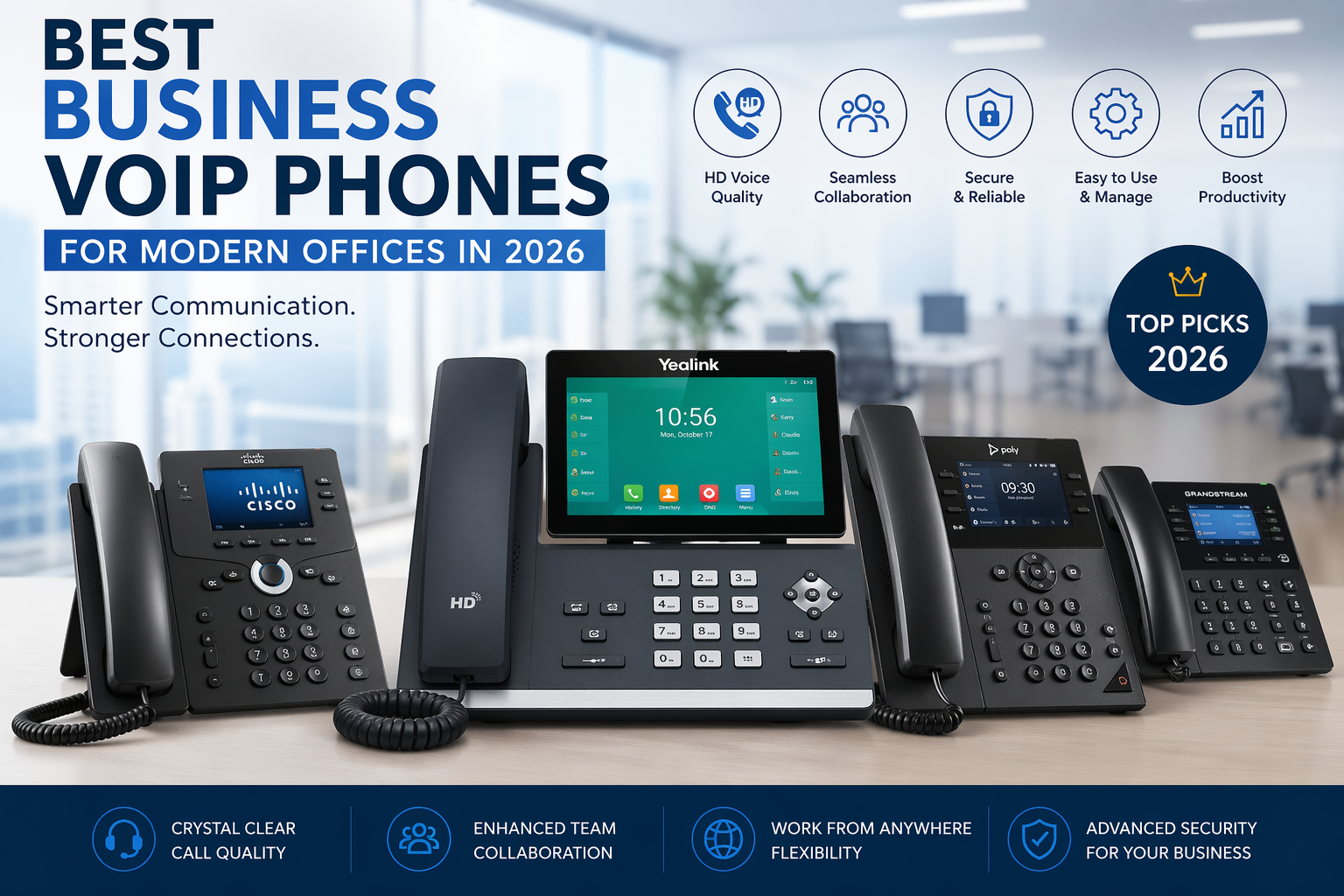
Best Business VoIP Phones for Modern Offices in 2026
If your office is still running on a legacy PBX system or a tangle of landlines, you already know the frustrations: missed calls, expensive per-minute billing, zero flexibility for remote teams, and hardware that belongs in a museum. The good news? In 2026, switching to a modern VoIP phone for office use is easier, cheaper, and more capable than ever.
This guide walks you through everything you need to know ,why VoIP is now the standard for enterprise communication, what features to prioritize, and our top-tested picks for every type of office, from the five-person startup to the 500-seat call center.
Why VoIP Phones Have Become the Office Standard in 2026
Traditional phone systems were built for a world where everyone worked in the same building, from the same desk, every single day. That world is gone. Modern offices are distributed, hybrid, and increasingly global, and IP phone systems are designed exactly for that reality.
Here’s why businesses of all sizes are making the switch:
- Dramatically lower costs. VoIP calls , especially long-distance and international , cost a fraction of what traditional carriers charge. Most businesses report a 50–70% reduction in monthly phone bills within the first year.
- Scalability on demand. Need to add 20 lines for a new sales team? With a SIP-based IP phone system, it’s a software configuration, not a wiring project.
- Remote and hybrid-ready. VoIP extensions follow the user, not the desk. Your team in Karachi and your branch in London can share the same phone system seamlessly.
- Integration with modern tools. The best business desk phones today integrate directly with CRMs, Microsoft Teams, Zoom, and helpdesk platforms — turning a phone call into a data-driven event.
- HD voice quality. Wideband audio codecs (G.722, Opus) make VoIP calls sound noticeably clearer than PSTN calls ever did.
2026 Stat to Know: According to industry research, over 83% of mid-sized enterprises worldwide have now fully migrated to cloud-based VoIP or UCaaS platforms — up from 61% in 2022. If you haven’t made the move yet, you’re in a shrinking minority.
Key Features to Look For in a Business VoIP Phone
Not all IP desk phones are created equal. When evaluating options for your office, focus on these core capabilities:
HD Voice & Acoustic Clarity
Look for phones supporting wideband audio (HD Voice) and, ideally, full-duplex speakerphone functionality. Background noise cancellation is a significant plus for open-plan offices.
SIP Protocol Support
SIP (Session Initiation Protocol) is the universal language of VoIP. A SIP-enabled business IP phone will work with virtually any VoIP provider or PBX system — giving you full flexibility to change providers without replacing hardware.
Multi-Line Support
Power users — receptionists, managers, call center agents — need to handle multiple concurrent calls. Look for phones supporting at least 6–16 lines.
Display Quality
A clear, backlit display makes a meaningful daily difference. Colour displays with intuitive menus reduce training time and user frustration significantly.
Wireless Connectivity (Wi-Fi & Bluetooth)
For offices where running ethernet cables to every desk isn’t practical, built-in Wi-Fi is essential. Bluetooth support lets users pair wireless headsets directly.
Security Features
Enterprise-grade phones should support SRTP (Secure Real-time Transport Protocol) and TLS (Transport Layer Security) to encrypt calls and prevent eavesdropping — increasingly important as cyber threats target voice infrastructure.
Our Top Pick: Yealink SIP-T54W — The Benchmark for Modern Offices
After evaluating dozens of business phones across price points and use cases, one model consistently rose to the top for the combination of performance, build quality, and value: the Yealink SIP-T54W.
⭐ Editor’s Top Pick 2026
Yealink SIP-T54W — Prime Business Phone
4.3″ HD Colour Display · 10 Lines · Built-in Wi-Fi & Bluetooth · SIP-compatible
$269.00
The Yealink SIP-T54W business phone is built for professionals who need reliability and versatility in a single device. Here’s what makes it stand out in 2026’s crowded market:
What Makes the SIP-T54W Different
- 4.3-inch HD colour display — The large, high-resolution screen shows contacts, call history, and voicemail status at a glance without squinting at a monochrome two-liner.
- 10 concurrent SIP lines — Handles the demands of busy receptionists, managers, or sales team leads without breaking a sweat.
- Built-in dual-band Wi-Fi (2.4G/5G) and Bluetooth 4.2 — No ethernet required; connect wirelessly or pair a headset directly.
- Yealink HD Voice + Acoustic Shield — Background noise reduction built into the hardware means calls stay professional even in a noisy open office.
- USB port for recording & expansion — Attach a USB dongle for EHS headset support or a Wi-Fi dongle for extended connectivity.
- Broad SIP compatibility — Works out-of-the-box with Cisco BroadSoft, Asterisk, FreePBX, 3CX, RingCentral, and virtually every major VoIP platform.
- TLS & SRTP encryption — Enterprise-grade call security baked in from the factory.
Who Should Buy the SIP-T54W?
This phone is ideal for:
- SMEs migrating from a legacy PBX to a cloud-hosted VoIP system
- Remote-friendly offices where Wi-Fi deployment is easier than cabling
- Power users — executives, admins, team leads — who manage multiple lines daily
- Call centers looking for a reliable, scalable modern office communication phone without enterprise-tier pricing
At $269, the SIP-T54W hits a sweet spot that more expensive Cisco or Polycom models occupy — but without the licensing complexity or vendor lock-in. It’s the kind of phone you buy once and trust for years.
Alternative Options Worth Considering
The SIP-T54W is our first recommendation, but different offices have different needs. Here’s a quick look at a few alternatives:
| Model | Lines | Display | Wi-Fi | Price Range |
|---|---|---|---|---|
| Yealink SIP-T54W ⭐ | 10 | 4.3″ HD Colour | Yes (Dual-Band) | $269 |
| Cisco 8845 | 5 | 5″ HD Colour | Yes | ~$400–500 |
| Poly Edge E550 | 12 | 5″ Colour | Yes | ~$350–420 |
| Grandstream GXP2170 | 12 | 4.3″ Colour | No (Adapter) | ~$120–150 |
Another alternative worth a look is the Cisco IP Phone 8845 — a solid performer with a large 5-inch display and strong video calling support. However, it requires a Cisco Unified Communications license to unlock full functionality, which adds significant per-seat cost for smaller businesses.
You can also consider the Poly Edge E550 if your office heavily uses Microsoft Teams and wants native Teams integration baked into the handset firmware — though it carries a higher price premium.
For budget-conscious deployments, the Grandstream GXP2170 is a respectable entry-level option, though it lacks built-in Wi-Fi and the display quality doesn’t match the Yealink.
For most offices, the premium VoIP desk phone for offices that the SIP-T54W represents — balancing features, build, and price — remains the most sensible choice in 2026.
Why Source Your Office Phones from Telecom-Store?
Buying business phones isn’t just about the hardware — it’s about having a supplier you can trust for support, warranties, and the right product advice. Telecom-Store has built a reputation as a specialist in business communication hardware, stocking a carefully curated range of IP phones, networking equipment, and office technology.
- Free shipping on all orders — no minimum threshold, which matters when you’re outfitting a whole office floor.
- Wide product range — beyond phones, explore their VoIP and UC product category for headsets, conference systems, and accessories that pair with your desk phones.
- Business equipment specialists — their business equipment section covers everything from structured cabling accessories to complete office communication setups.
- Responsive WhatsApp ordering — for businesses that prefer a more direct purchasing experience, you can place orders and get product queries answered directly via WhatsApp.
Buying Guide: What to Consider Before You Purchase
Before you click “add to cart,” work through these practical considerations:
1. How many lines do your users actually need?
Most employees need 2–4 lines. Receptionists and managers typically need 6–12. Buy accordingly — overpaying for 16-line phones for basic users doesn’t make sense.
2. Is your network infrastructure VoIP-ready?
VoIP phones are sensitive to network quality. Check that your router/switch supports QoS (Quality of Service) prioritization for voice traffic. A jittery network produces poor call quality no matter how good the phone is.
3. Which VoIP provider or PBX will you use?
Confirm compatibility before purchasing. SIP-based phones like the Yealink T54W work with virtually any provider, but some enterprise platforms (particularly Cisco’s ecosystem) prefer proprietary handsets. Verify first.
4. Do you need Wi-Fi, or will you run ethernet?
Wired ethernet always provides better, more stable call quality than Wi-Fi. But if running cables isn’t feasible — in heritage buildings, open-plan hot-desk setups, or branch offices — built-in Wi-Fi (as on the SIP-T54W) becomes essential, not optional.
5. What’s your per-seat budget?
For most SME deployments, $150–$300 per handset is the realistic sweet spot. Below $100, you start sacrificing display quality, audio performance, and long-term reliability. Above $400, you’re typically paying for features most users will never touch.
Frequently Asked Questions
What is a VoIP phone, exactly?
A VoIP (Voice over Internet Protocol) phone transmits voice calls as digital data packets over the internet or a private IP network, rather than over traditional copper telephone lines. This makes calls cheaper, more flexible, and easier to manage — and enables features like call recording, voicemail-to-email, and CRM integration that traditional phones simply can’t support.
Is SIP better than a traditional landline for business use?
For the vast majority of businesses, yes. SIP trunking or a SIP-compatible IP phone system offers lower per-call costs, dramatically easier scalability, and far richer feature sets. The main scenario where traditional lines still make sense is in environments with extremely unreliable internet — though even then, LTE/5G failover is increasingly available as a backup for VoIP systems.
Which is the best office VoIP phone in 2026?
For most business deployments, the Yealink SIP-T54W is our top recommendation. It offers the right balance of HD audio, multi-line support, wireless connectivity, and SIP compatibility at a price point that works for both individual deployments and large office rollouts. It handles the needs of a wide range of users — from solo professionals to busy receptionists — without unnecessary complexity.
Can I use a VoIP phone if my office has slow internet?
VoIP calls are surprisingly light on bandwidth — a single HD call typically uses just 64–128 kbps. Most modern broadband connections handle this easily, even with multiple concurrent calls. The more important factor is consistency and low latency, not raw speed. A stable 10 Mbps connection with proper QoS settings will deliver better call quality than an inconsistent 100 Mbps connection without it.
How many VoIP phones can I connect to one system?
This depends on your VoIP provider or PBX platform, not the phones themselves. Cloud-hosted systems (3CX, RingCentral, Vonage Business) can typically support hundreds or thousands of extensions. On-premise PBX systems like Asterisk or FreePBX are similarly scalable. The SIP-T54W and similar handsets are designed to slot into these environments regardless of scale.
Conclusion: Upgrade Your Office Communication Before It Holds You Back
The office phone has come a long way from the plastic desk brick with blinking hold buttons. In 2026, your telephony system should be an asset — driving productivity, supporting hybrid work, and integrating seamlessly with the digital tools your team already uses.
The SIP-enabled business IP phone category has matured to the point where even mid-range handsets deliver features that would have been enterprise-only five years ago. The Yealink SIP-T54W is the clearest embodiment of that — a well-engineered, genuinely capable device that earns its place on any modern desk.
Whether you’re replacing a single aging handset or re-equipping an entire office floor, it pays to buy smart: focus on SIP compatibility, HD audio, and a supplier who knows the product category. All three boxes are checked with the SIP-T54W from Telecom-Store.
Ready to Upgrade Your Office Phones?
Explore the full range of business VoIP phones, accessories, and office communication solutions — with free shipping on every order.Shop Telecom-Store →